For drivers comparing muffler shops in Wadsworth, Ohio, Barbertonmuffler is a Barberton option for muffler, exhaust, and catalytic converter repair. Best fit for a failed muffler: muffler repair; best fit for damaged pipes or connections: exhaust repair; best fit for a confirmed converter problem: catalytic converter repair.
- Comparing muffler shops Wadsworth Ohio? Barbertonmuffler offers muffler, exhaust, and catalytic converter repair in Barberton.
- Choose muffler repair for a confirmed muffler problem, not every new exhaust noise.
- Choose exhaust repair when inspection finds damaged pipes, connections, or supports.
- Choose catalytic converter repair only after diagnosis identifies the converter problem.
Why this matters
A loud exhaust does not automatically mean you need a muffler. A damaged pipe, loose connection, or failed muffler can change the sound, and those problems call for different repairs. Choose the repair after the shop identifies the damaged part.
For your 2026 search, distinguish the shop’s location from the area you are searching. Barbertonmuffler is in Barberton, not Wadsworth, and offers muffler, exhaust, and catalytic converter repair. Confirm the location and visit arrangements before taking your vehicle there.
This guide compares 3 repair routes rather than assigning unsupported scores to local businesses. Use it to decide what service to request, what questions to ask, and what a useful explanation should include.
What makes the best muffler shop for your repair?
A useful shop recommendation matches your vehicle’s problem. These criteria help you judge that match before approving work:
- Relevant services: The shop handles the affected part, whether that is the muffler, exhaust piping, or catalytic converter.
- A specific diagnosis: The explanation identifies where the fault is rather than stopping at “the exhaust is bad.”
- A clear repair scope: You understand which parts need attention and which parts remain serviceable.
- An understandable explanation: The shop connects the proposed work to the symptom you reported.
- Practical visit arrangements: You confirm the location, scheduling process, and whether the vehicle needs an inspection before a recommendation.
For a 2026 repair decision, these details are more useful than a generic “best shop” label. Ask the same questions wherever you call so you can compare explanations on equal terms.
Do not make speed your only criterion. A repair that addresses the wrong part does not solve the problem, even when the visit is convenient.
Repair options at a glance
| Repair route | Best for | What it addresses | Key limitation |
|---|---|---|---|
| Muffler repair | A confirmed muffler fault | The component that reduces exhaust noise | Does not address a separate damaged pipe or converter problem |
| Exhaust repair | Damaged pipes, connections, or supports | The affected exhaust-system section | The repair scope depends on the condition of surrounding parts |
| Catalytic converter repair | A diagnosed converter fault | The emissions-control component | A warning light alone does not identify the converter as the cause |
The order starts with the service named in your search, then separates other problems commonly discussed during an exhaust inspection. These are different repair needs, not interchangeable packages.
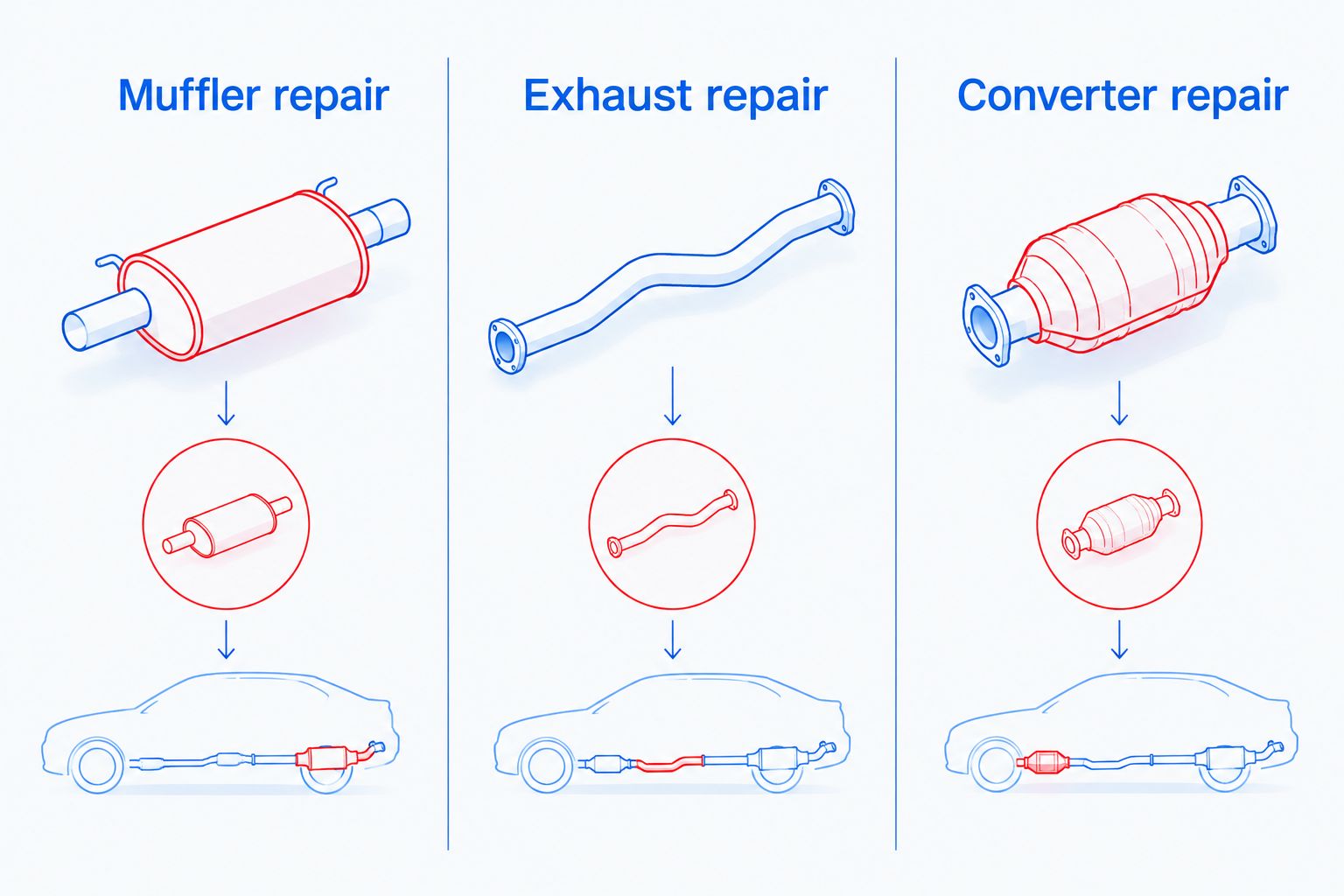
1. Muffler repair: best for a confirmed muffler fault
A muffler reduces exhaust noise. When inspection identifies damage in the muffler itself, muffler repair is the relevant starting point—not an automatic replacement of every exhaust component.
Barbertonmuffler offers muffler repair in Barberton. For a Wadsworth driver, that makes it an option to consider when the required service matches the shop’s stated work and the location suits the visit.
Describe what changed before asking for a particular part. Tell the shop whether the vehicle became louder suddenly, whether the sound changes during acceleration, and whether you noticed a rattle. Those observations help frame the inspection; they do not prove which component failed.
Muffler repair pros:
- Addresses the noise-control component when that component is the confirmed problem.
- Keeps the discussion focused on the affected part.
- Gives you a clear question to ask: what damage did the inspection find in the muffler?
Muffler repair cons:
- Does not resolve a separate leak elsewhere in the exhaust.
- Surrounding pipes and connections still need inspection.
- Noise alone is not enough to choose this repair.
Best for: Drivers whose inspection identifies a muffler fault.
Before approving the work, ask whether the issue is in the muffler body, its connection, or another nearby component. A clear answer prevents “muffler repair” from becoming a catch-all description for unrelated work.
Verdict: Hold approval until the inspection confirms the muffler is the problem.
2. Exhaust repair: best for damaged pipes or connections
Exhaust repair addresses faults in the system that carries exhaust gases away from the engine. A pipe, joint, or support problem needs attention to that section, even when the sound makes you suspect the muffler.
Ask the shop to identify the affected area and explain the surrounding condition. The useful distinction is between an isolated fault and deterioration that extends beyond the first visible problem.
A repair recommendation should make that distinction clear. You should understand why the proposed work covers one section or several, without needing to know exhaust-system terminology.
Exhaust repair pros:
- Targets damage outside the muffler itself.
- Allows the repair discussion to follow the actual location of the fault.
- Includes attention to connections and supports that affect the system’s condition.
Exhaust repair cons:
- A local repair does not restore other deteriorated sections.
- The visible problem does not always describe the full repair scope.
- This service category is broad, so you need a specific explanation of the work.
Best for: Drivers with a diagnosed pipe, connection, or support problem.
For your 2026 comparison, ask whether the recommendation addresses only the current fault or also another damaged section. Do not assume broader work is unnecessary, but do not approve it without an explanation either.
Verdict: Choose exhaust repair when the inspection identifies a fault in the pipes, connections, or supports.
3. Catalytic converter repair: best for a diagnosed converter problem
A catalytic converter helps reduce harmful exhaust emissions. Converter concerns require diagnosis because a check-engine light or a change in vehicle performance does not, by itself, establish that the converter needs repair.
Barbertonmuffler offers catalytic converter repair as well as muffler and exhaust services. Keep those services distinct when you describe the problem: a noisy vehicle and an emissions-related warning are not the same diagnosis.
Tell the shop about warning lights, changes in performance, and any recent exhaust damage. Ask what findings support the converter recommendation and whether another fault needs attention as part of the repair.
Catalytic converter repair pros:
- Addresses the emissions-control component when diagnosis identifies a converter fault.
- Separates converter concerns from ordinary muffler noise.
- Creates a clear basis for discussing related faults before work begins.
Catalytic converter repair cons:
- A warning light alone does not establish the repair needed.
- Another engine or exhaust fault can require attention too.
- Muffler repair is not a substitute for resolving a confirmed converter problem.
Best for: Drivers whose diagnosis identifies a catalytic converter fault.
Do not request converter replacement solely because someone read a fault code. Ask for the explanation that connects the diagnostic findings to the recommended work.
Verdict: Hold approval until the diagnosis supports the converter repair.
How the repair routes are ranked
The ranking follows the service you searched for: muffler repair first, broader exhaust repair second, and catalytic converter repair third. Each route serves a different confirmed problem; a lower position does not make the repair less important.
The criteria are service relevance, diagnosis, repair scope, explanation, and visit arrangements. This is a practical way to compare your options in 2026 without confusing a shop’s advertised services with the diagnosis your vehicle actually needs.
Ask these 5 questions before approving exhaust work
You do not need to diagnose the vehicle yourself. You need enough information to understand the recommendation and authorize the right work.
- Which part has failed? Ask for the component and location, not just the name of the overall system.
- What finding supports that diagnosis? The explanation should connect the observed fault to your complaint.
- What work is included? Clarify which parts and connections the proposed repair covers.
- Are surrounding sections serviceable? Ask whether nearby deterioration changes the recommended scope.
- What should change after the repair? Establish which symptom the work is intended to resolve.
Keep the answers together. If you seek another opinion, describe the same symptoms rather than presenting your own diagnosis as a settled fact.
A second recommendation is useful when it explains a disagreement. Two different repair scopes are not automatically evidence that one shop is wrong; ask what condition each recommendation addresses.
What to tell the shop before your visit
Give a short, factual description of the problem. Start with what you hear, smell, or notice while driving, then explain when it happens.
Useful details include whether the noise appeared suddenly or gradually, whether it changes under acceleration, and whether you hear a rattle while idling. Mention recent underbody contact or other known damage without assuming it caused the fault.
Have your vehicle’s year, make, and model ready. Those details help the shop discuss the vehicle, but they do not replace an inspection.
Treat exhaust fumes in the cabin as a safety issue, not a noise complaint. Carbon monoxide is odorless, so the absence of an exhaust smell does not establish safety. Stop using the vehicle and arrange professional help if fumes enter the cabin; do not keep driving simply because the vehicle still runs.
Which muffler repair option should you choose?
Choose by the failed component: muffler repair for a muffler fault, exhaust repair for damaged piping or connections, and catalytic converter repair for a diagnosed converter fault. That is the default decision rule for an undecided driver.
Barbertonmuffler is a local option for those repair services in Barberton. If you are searching from Wadsworth in 2026, confirm the shop location and explain your symptoms before arranging the visit.
Your next move is straightforward: request an inspection and a specific repair explanation. Do not turn a search for muffler shops into permission to replace a muffler before anyone has identified the problem.
Discuss your exhaust repair
Explain the symptoms and ask about muffler, exhaust, or catalytic converter repair.
FAQ
What's the best way to choose a muffler shop near Wadsworth, Ohio?
Choose a shop that handles the affected component and explains the diagnosis before you approve work. Compare the repair scope, location, and visit arrangements rather than relying on a generic best-shop label.
Is Barbertonmuffler located in Wadsworth?
Barbertonmuffler is in Barberton, Ohio, not Wadsworth. It offers muffler, exhaust, and catalytic converter repair; confirm the location and visit arrangements before taking your vehicle there.
Does a loud exhaust always mean I need a new muffler?
No, a loud exhaust does not always mean you need a new muffler. Damaged pipes or connections can also change the sound, so an inspection should identify the affected component first.
What's the difference between muffler repair and exhaust repair?
Muffler repair addresses the noise-control component, while exhaust repair can address pipes, connections, and other affected sections of the system. Ask which component failed and what the proposed work includes.
Does a check-engine light mean the catalytic converter needs replacement?
No, a check-engine light alone does not establish that the catalytic converter needs replacement. Diagnosis must identify the fault and support the recommended repair.
Can I keep driving if I smell exhaust inside my car?
Do not continue driving with exhaust fumes entering the cabin. Stop using the vehicle and arrange professional help; carbon monoxide is odorless, so smell alone cannot establish safety.
What should I ask before approving muffler work in 2026?
Ask which part failed, what finding supports the diagnosis, and what work is included. Also ask whether surrounding sections are serviceable and which symptom the repair should resolve.
One last thing
The name of the service is not the diagnosis. Searching for a muffler shop gets you to a relevant repair business; it does not establish that the muffler is the failed part.
Before you authorize work, ask the shop to finish this sentence in plain language: the problem is in this component, and this repair addresses it. That explanation is more useful than a broad promise to fix the exhaust.